The VA Agent window is where VA Intelligence shows its work. When you run Change Code with AI, the agent works on your open solution: it reads, searches, and edits code through Visual Assist’s own tools, answers your questions about the code, and proposes changes. Its response and each proposed change appear here, so you can review every change before it reaches your code.
Open the VA Agent Window
Before you start, make sure VA Intelligence is enabled and installed. Then, go to Extensions > VAssistX > Tools > VA Agent.
The VA Agent window opens and shows the agent’s response.
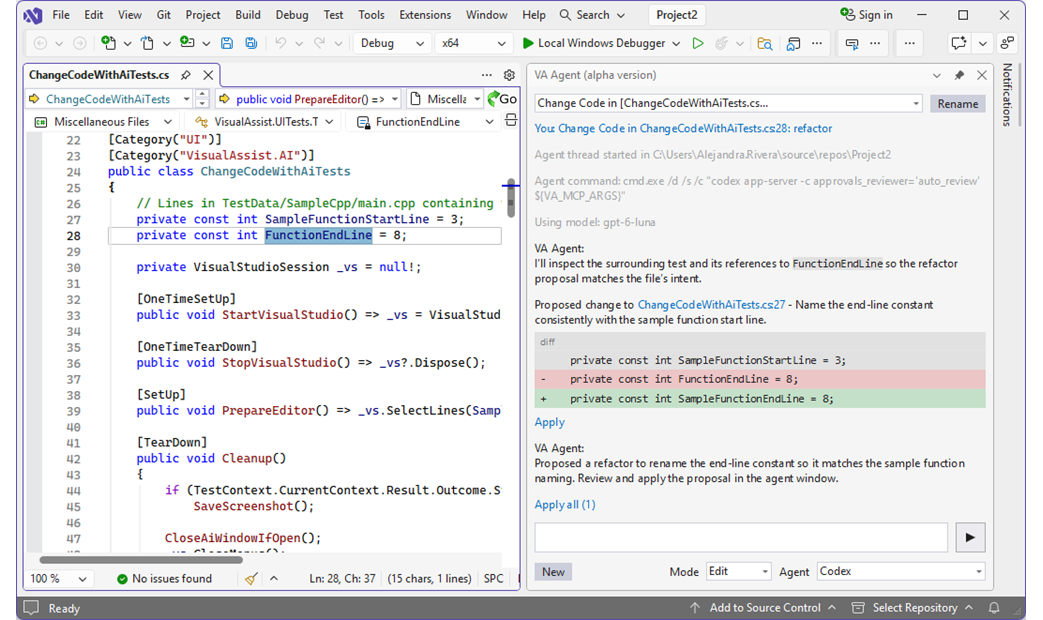
In the VA Agent window, you can perform the following operations:
- Choose an agent and a mode.
- Review and apply proposed changes.
- Manage conversations: open, rename, or start new ones.
Agent Picker
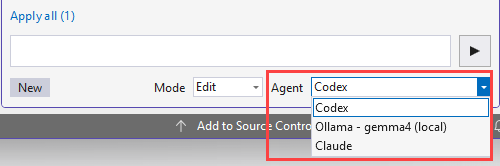
Use the Agent picker to choose one of the following agents:
- Codex (default): uses OpenAI’s Codex agent. Requires Codex CLI installed and signed in with an OpenAI account.
- Ollama - gemma4 (local): runs locally on your computer using the Gemma model installed with VA Intelligence. No sign-in is needed.
- Claude Code: uses Anthropic’s Claude agent. Requires Claude Code CLI installed and signed in with an Anthropic account.
For setup steps, see AI agent setup.
Codex and Claude Code send your code to their providers (OpenAI and Anthropic) for processing. The local agent keeps your code on your computer.
Mode Picker
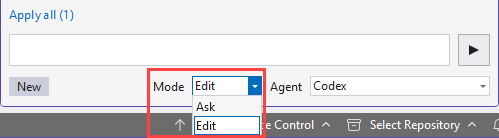
Use the Mode picker to choose what the agent is allowed to do.
- Edit (default): the agent can edit files and run commands in the solution directory.
- Ask: the agent reads your code and answers your questions, but cannot edit files or run commands.
Use Ask mode when you want explanations or suggestions without any changes to your files. Switch to Edit mode when you want the agent to make changes.
Review and Apply Proposed Changes
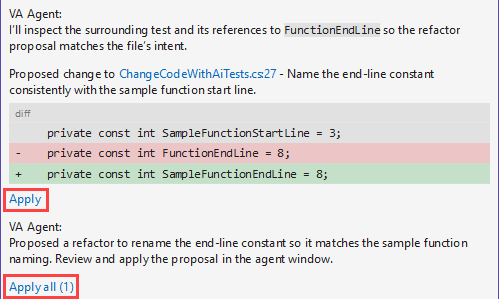
When you run Change Code with AI, the proposed changes stream into the VA Agent window as diff blocks.
Each diff block shows a before-and-after comparison so you can inspect the proposed code before deciding what to keep.
- Click Apply on a diff block to apply that change.
- Click Apply all to apply all changes at once.
No changes are applied to your code until you click Apply. Diff blocks you do not apply leave your code unchanged.
Open Previous Conversations
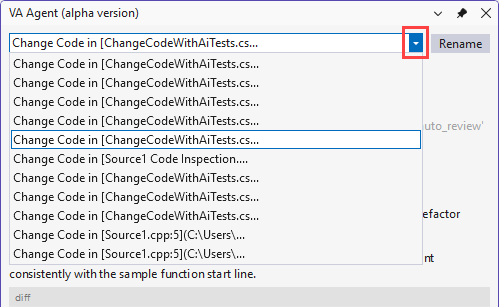
The VA Agent window keeps a history of your previous conversations, so you can return to an earlier request and continue where you left off.
- On the top left side of the VA Agent window, expand the history control.
- Select a conversation to open it.
Opening a previous conversation does not apply any changes.
Create New Conversations
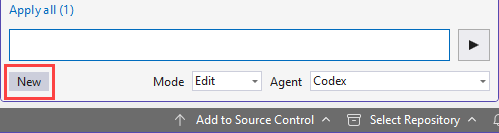
Click New to start a new conversation.
Rename Conversations
- On the top right side of the VA Agent window, click the Rename icon.
- Type the new name.
- Click Ok to save the changes.

Check Status
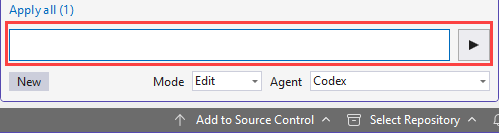
Type /status in the message box and send it to see how much of the context window the agent is using and whether your CPU or GPU is doing the work.
Set the Context Length (local agent)
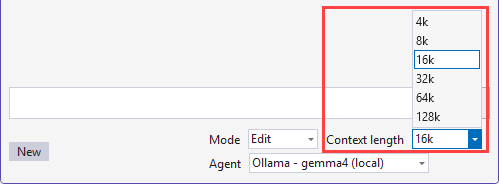
The Context length setting controls the size of the context window for the local agent (Ollama - gemma4). A longer context lets the agent consider more code and conversation at once, but it uses more memory.
- Range: 4K to 128K
- Default: 16K
Recommended Use
- Start in Ask mode when you are exploring unfamiliar code or want to discuss an approach before changing anything.
- Review each diff block before applying it, and apply changes one at a time when the result needs closer inspection.
- Rename conversations you plan to return to, so you can find them quickly.
- Treat the output as proposed code, not automatically trusted code.
- You can run several conversations at the same time.
To review the Basic Workflow, see Change Code with AI.